The Hidden Danger of Towing: Rear Axle Weight Rating (RAWR) Explained
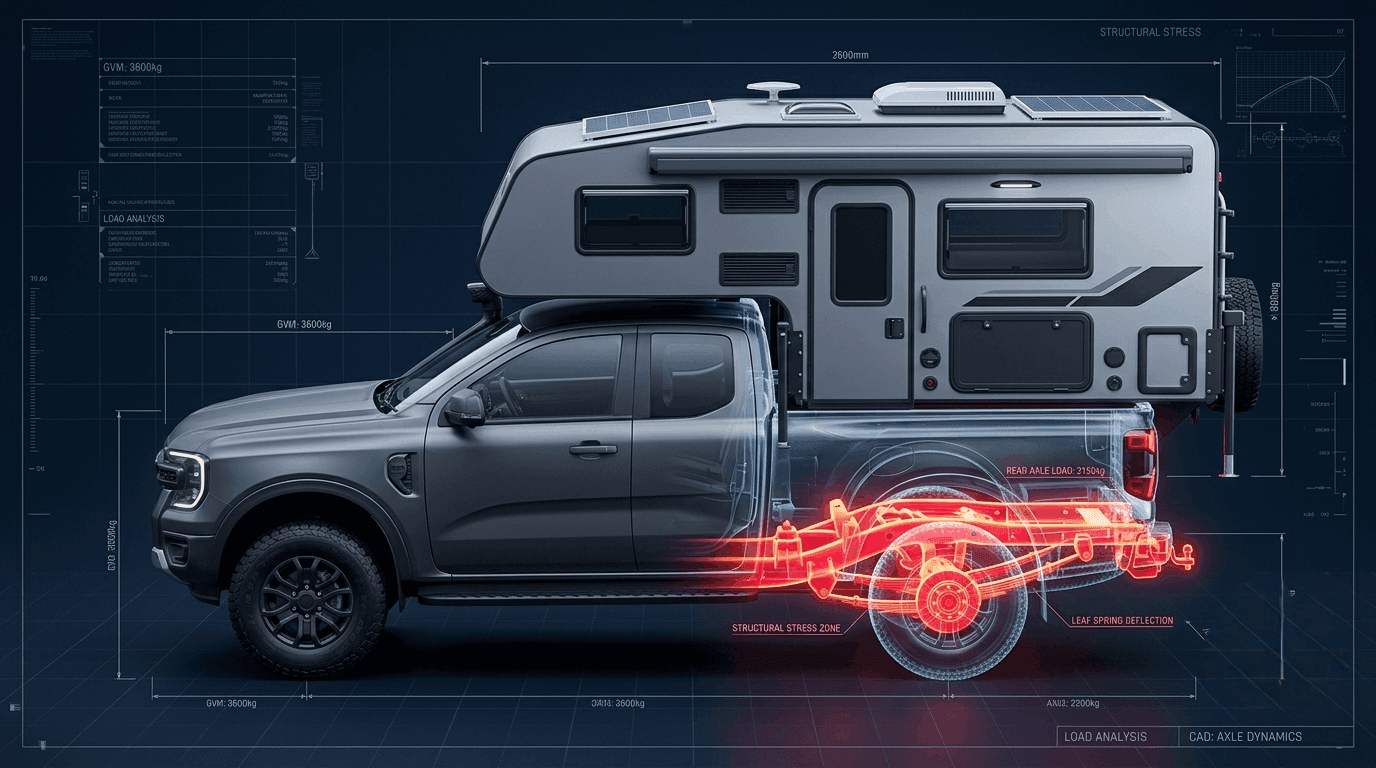
Extensive engineering analyses and real-world highway data indicate a systemic misunderstanding of payload distribution among modern 4x4 dual-cab ute owners. While total payload and Gross Vehicle Mass (GVM) are frequently discussed, the most critical threshold for structural integrity—the Rear Axle Weight Rating (RAWR)—is largely ignored, leading to catastrophic mechanical failures.
Introduction to Vehicle Weight Dynamics and the RAWR Deficit
The contemporary dual-cab utility vehicle is marketed as a versatile workhorse, capable of hauling heavy loads while providing passenger vehicle comfort. However, this hybrid design introduces significant engineering compromises. When outfitting a vehicle for long-range touring—involving heavy slide-on campers, long-wheelbase caravans, or heavily laden canopies—the distribution of that weight becomes a critical matter of physics rather than simple arithmetic.
Drivers frequently calculate their compliance by subtracting their vehicle's Tare weight from its Gross Vehicle Mass (GVM). If the remaining payload capacity is 900kg, and their equipment weighs 850kg, they assume strict legal and mechanical compliance. This assumption is fundamentally flawed. Weight is not distributed equally across a vehicle's chassis. The placement of mass relative to the vehicle's axles determines the actual load sustained by internal components, making the rear axle weight rating explained a mandatory topic for any serious towing education.
Defining Rear Axle Weight Rating (RAWR) Technically
The Rear Axle Weight Rating (RAWR) is the absolute maximum weight that the vehicle manufacturer guarantees the rear axle assembly can safely sustain. This specification is not a singular measurement of the steel axle tube; it represents the weakest link in a complex mechanical chain. The RAWR encompasses:
- Axle Housing and Tubes: The structural steel casing that resists bending and torsional flex under static and dynamic loads.
- Wheel Bearings: The rotational components that bear the entire vertical load of the rear of the vehicle.
- Differential Assembly: The internal gearing which experiences increased heat and friction under heavy loads.
- Suspension Components: Leaf springs, coil springs, shock absorbers, and mounting brackets engineered for specific compression rates.
- Braking Systems: The mechanical capacity of the rear rotors or drums to arrest the forward momentum of the applied weight.
- Tyre Load Ratings: The pneumatic capacity of the tires to maintain structural integrity without excessive sidewall flex or blowout risk.
Exceeding the RAWR means exceeding the engineered safety tolerances of one or more of these critical components, severely compromising the vehicle's operational safety.
The Physics of Leverage: Why Tow Ball Weight is Deceiving
A common miscalculation occurs when factoring in the Tow Ball Mass (TBM) or Tow Ball Weight (TBW) of a caravan. It is a fundamental law of physics that mass applied behind a fulcrum (the rear axle) acts as a lever. This is the exact mechanical reason behind the phenomenon of the slide on camper bent chassis and varying dual cab ute payload limits.
Because the tow hitch is located significantly behind the rear axle—often up to a meter or more depending on the tray configuration—any weight applied to the tow ball multiplies the downward force exerted on the rear axle while simultaneously lifting the front axle.
The Mathematical Reality:
If a caravan applies 250kg of downward force on the tow ball, it does not merely add 250kg to the rear axle. Due to the leverage effect created by the overhang distance, that 250kg can translate to roughly 350kg to 370kg of applied load on the rear axle. Concurrently, it creates a negative load (lift) of approximately 100kg to 120kg on the front axle.
This loss of weight on the front axle drastically reduces steering traction and braking efficiency, creating a highly unstable geometry. It is this precise loss of control that necessitates the installation of a high-quality trailer sway control kit to mechanically mitigate the unstable oscillations caused by incorrect weight distribution.
The GVM Upgrade Misconception: Compliance vs. Capability
In the pursuit of higher payload capacities, the automotive aftermarket industry has heavily promoted Gross Vehicle Mass (GVM) upgrades. Consequently, researching the average GVM upgrade cost has become a standard part of the vehicle purchasing process. However, a dangerous misconception persists that a GVM upgrade automatically fortifies the entire vehicle structure, including the rear axle.
In Australia, under the Second Stage of Manufacture (SSM) scheme or through state-based engineering certification, a GVM upgrade primarily involves a heavy-duty 4x4 suspension upgrade—stiffer springs and matched shock absorbers designed to carry a heavier total load without sagging.
Crucially, unless explicitly stated and engineered (which often requires complete replacement of the axle housing assembly), a GVM upgrade does not increase the OEM Rear Axle Weight Rating.
A vehicle may receive a GVM increase from 3,200kg to 3,500kg, granting an additional 300kg of on-paper payload. If an owner places that entire 300kg into a rear canopy or applies it via a heavy caravan tow ball, they may remain strictly under their new 3,500kg GVM, yet drastically exceed their unmodified 1,850kg Rear Axle Weight Rating. The vehicle is theoretically legal by GVM, but mechanically compromised and illegally overloaded by axle capacity.
Mechanical Consequences of RAWR Exceedance
Operating a vehicle beyond its Rear Axle Weight Rating initiates a cascade of mechanical failures due to cyclic fatigue and dynamic loading. When a vehicle hits a pothole or navigates a corrugation at highway speeds, the static load multiplies exponentially.
- Chassis Deformation: Dual-cab utes feature a ladder-frame chassis. The point where the cab ends and the tray begins is a natural stress concentrator. Extreme rear axle loads cause the chassis rails to flex downward repeatedly, eventually leading to micro-fractures and catastrophic chassis snapping.
- Wheel Bearing Failure: Overloaded bearings generate excessive heat, degrading the lubricating grease. This leads to rapid metal-on-metal friction, bearing collapse, and in extreme cases, the axle shaft separating from the housing while in motion.
- Differential Overheating: Increased weight requires the differential to process more torque to maintain momentum. The resulting friction exponentially increases gear oil temperatures, breaking down its viscosity and leading to premature gear failure.
Insurance and Legal Implications of Overloading
Beyond the severe mechanical risks, the financial and legal ramifications of exceeding RAWR are absolute. Insurance policies are legally binding contracts predicated on the vehicle operating within manufacturer and statutory parameters.
In the event of a significant collision, forensic assessors routinely weigh the vehicle salvage and analyze the loading distribution. If empirical data proves the vehicle exceeded its RAWR, the vehicle is deemed unroadworthy at the time of the incident. This provides insurers with irrefutable grounds to deny the claim in its entirety.
Before finalizing any caravan insurance quote Australia, policyholders must understand their obligation to maintain axle compliance. A denied claim leaves the operator liable for the total loss of their vehicle, the caravan, recovery costs, and potentially millions of dollars in third-party property and medical liabilities. Furthermore, Highway Patrol units across jurisdictions are increasingly utilizing portable scale pads targeting recreational towers specifically for individual axle weight compliance.
Methodology for Verification and Compliance
Achieving compliance requires empirical data, not estimations. The only verified method to ensure RAWR compliance is through the utilization of a certified public weighbridge. The protocol for obtaining accurate axle weights is as follows:
- Load the vehicle exactly as it will be configured for travel, including all passengers, full fuel tanks, water bladders, accessories, and with the fully loaded caravan attached.
- Position the vehicle so that only the front axle rests on the weighbridge scale pad. Record this metric.
- Pull forward until only the rear axle rests on the scale pad. Record this metric.
- Ensure the rear axle measurement is strictly below the manufacturer's maximum specified RAWR (found on the compliance placard).
If the rear axle is overloaded, the mass must be redistributed. This may involve moving heavy items (like batteries, water tanks, or toolboxes) forward of the rear axle, reducing the tow ball weight of the caravan, or fundamentally rethinking the equipment payload. Relying on aftermarket airbags to level the ride height does not alter the mass acting upon the axle and is entirely superficial regarding legal compliance.