The Slide-On Camper Payload Trap: Why Your Ute Might Be Illegal
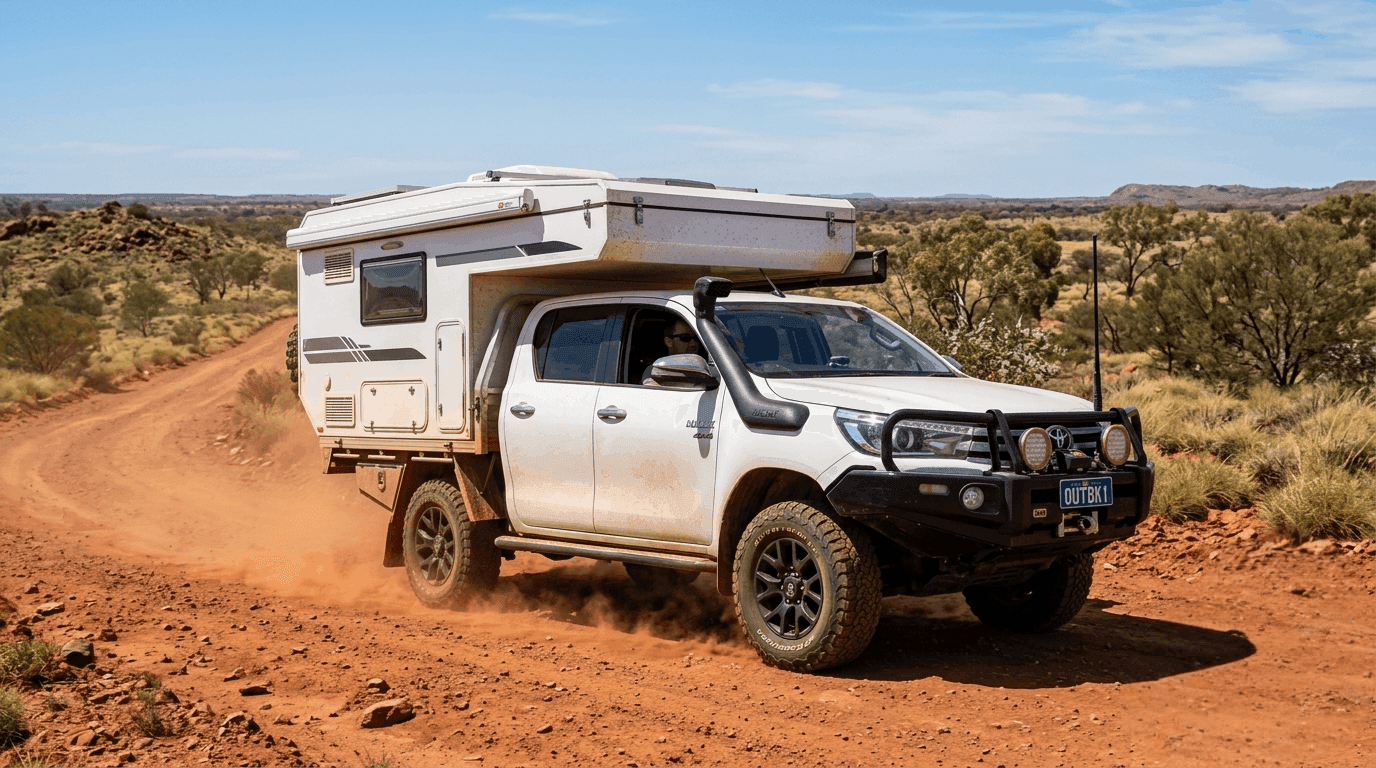
If there’s one topic that gets the campfire arguments fired up in the Australian outback, it’s slide-on campers. On paper, they look like the ultimate touring cheat code. You get the comfort of a caravan, you don’t have to tow anything, and you can still tackle the gnarliest 4WD tracks. But as someone who has spent years analyzing touring setups, I need to share a brutal truth: Slide-on campers are the biggest payload trap in the 4x4 world.
I have seen too many broken dreams, voided insurance policies, and literally snapped chassis out on the tracks. Dealerships will happily sell you a massive, fully-equipped slide-on box and lower it onto your standard dual-cab ute while telling you, "She'll be right, mate."
Spoiler alert: She won't be right. Let's strip away the marketing brochures and dive deep into the real-world math, the dry weight lies, and the silent chassis killer that nobody warns you about.
The "Dry Weight" Illusion (And Why Salesmen Love It)
The trap always begins in the showroom. You walk in, and you see a beautiful, fiberglass slide-on camper. You look at the spec sheet, and it proudly advertises a "Dry Weight" (or Tare Weight) of 500kg.
You do some quick mental math: Your trusty dual-cab ute (let's say a Ford Ranger, Toyota Hilux, or Isuzu D-Max) has a payload capacity of around 950kg. You think, "950kg minus 500kg... I've got 450kg of payload left! That's heaps!"
This is exactly where the disaster starts. "Dry weight" is a mythical number. It represents the camper completely empty—no water, no gas bottles, no deep cycle batteries, no solar panels, no fridge contents, and certainly no camping chairs or clothes. It is a useless metric for a touring setup.
The Real-World Math (A Wake-Up Call)
Let’s do the actual math of what happens when you prep that 500kg "dry" camper for a weekend away off-grid.
- The Camper: 500kg
- Water Tank (100 Litres): 100kg
- Gas Bottles (2 x 4.5kg full): 16kg
- Food, Drinks & Fridge contents: 40kg
- Bedding, Clothes & Pots/Pans: 40kg
- Batteries & Solar (if not included in dry weight): 60kg
- Recovery Gear & Tools: 30kg
Suddenly, your 500kg camper actually weighs 786kg.
Now, let's look at your Ute. That 950kg factory payload capacity doesn't just include the camper. It includes everything you’ve added to the vehicle since it rolled out of the factory.
- Heavy Duty Steel/Alloy Tray (Required for slide-ons): 150kg
- Steel Bullbar & Winch: 100kg
- Two Adults in the cab: 170kg
- Long Range Fuel Tank (Extra fuel weight): 60kg
That’s 480kg of vehicle accessories and humans. Combine that with your 786kg "loaded" camper, and you are putting 1,266kg of payload onto a vehicle designed to carry 950kg. You are massively over your Gross Vehicle Mass (GVM). You are driving an illegal, uninsurable, and highly dangerous vehicle.
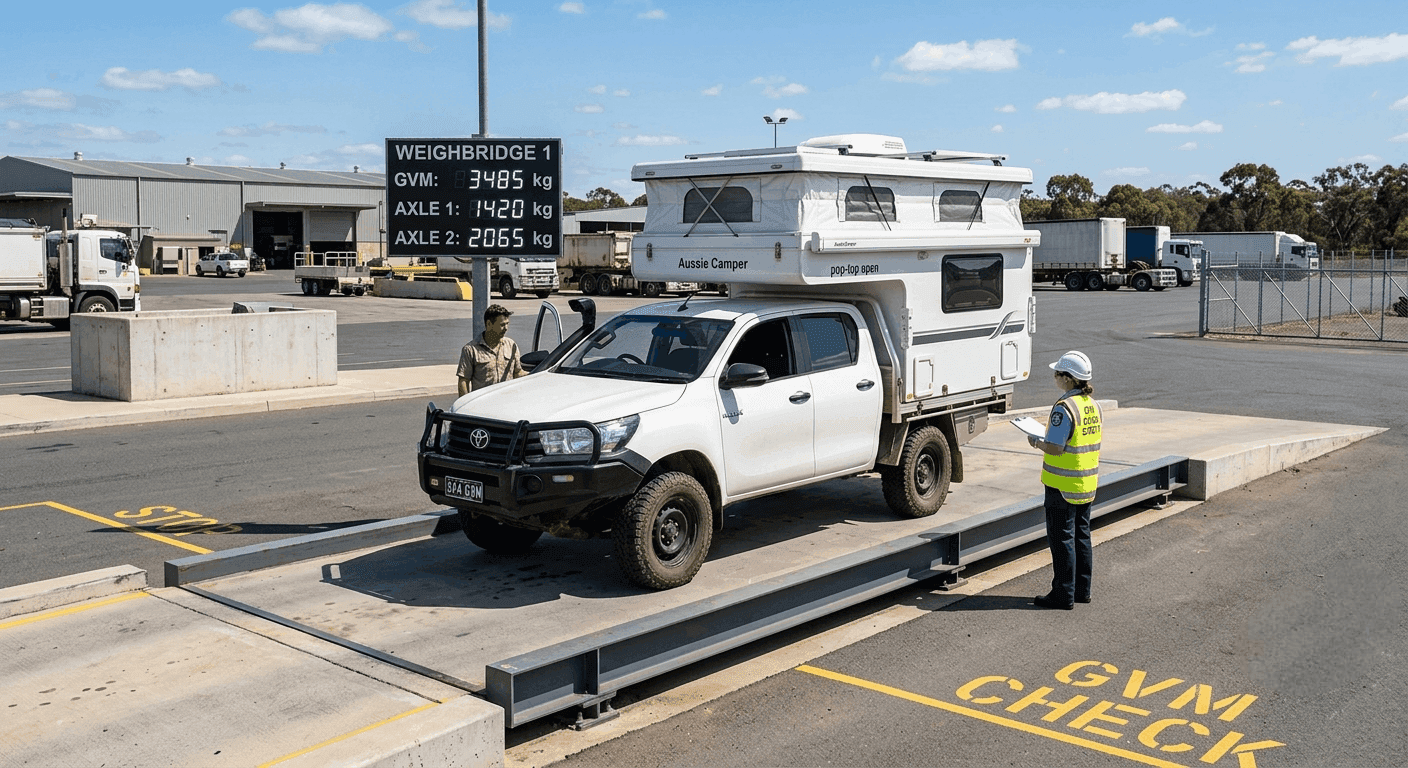
The Silent Killer: Rear Axle Weight Rating (RAWR)
Here is the most critical piece of engineering that most first-timers miss. Even if you manage to upgrade your vehicle's GVM to safely carry the total weight, you might still snap your chassis in half. Why? Because of the Rear Axle Weight Rating (RAWR).
GVM is the total weight allowed across all four wheels. But vehicle manufacturers also specify a maximum load for the front axle, and a maximum load for the rear axle.
When you tow a caravan, usually only 10% of the caravan's weight (the Tow Ball Weight) rests on the rear of your car. But with a slide-on camper, 100% of the camper's mass is sitting in the tray.
Because of the design of modern dual-cab utes, the center of the tray is located directly over, or even slightly behind, the rear axle. This creates a leverage effect. When you drop an 800kg loaded camper onto a dual-cab, it doesn’t push down on the front wheels; it actually lifts the front wheels slightly and concentrates almost the entire 800kg force squarely onto the rear suspension and chassis rails.
This intense, highly concentrated load point is exactly why we see so many images of dual-cab utes "bending" or snapping their chassis between the cab and the tray on corrugated outback roads. The total GVM might have been okay, but the RAWR was exceeded by hundreds of kilos.
The "Airbag" Myth (No, They Don't Increase Payload)
I hear it at caravan parks all the time: "Yeah mate, she's a bit heavy, but I put some airbags in the back, so she handles it fine."
Let me be crystal clear: Suspension upgrades—whether they are heavy-duty leaf springs, 500kg constant load springs, or pneumatic airbags—do not legally increase your payload or your GVM unless they are part of a certified, engineered GVM upgrade with a compliance plate.
Slapping airbags on a standard suspension just masks the problem. It raises the sagging rear end so the car looks level, but the physical weight is still there. Worse yet, incorrectly installed airbags change the load distribution on the chassis rail. Instead of the weight spreading across the whole leaf spring mount, the airbag punches all that weight into a single, small point on the chassis. Hitting a large bump at 80km/h with max-pressure airbags and a heavy slide-on is a guaranteed recipe for a bent chassis.
How to Actually Do It Right (The Blueprint)
I am not saying you shouldn't buy a slide-on camper. They are incredible pieces of kit for touring places where towing is impossible. But if you want to do it safely and legally, you need to approach it like an engineer, not just a consumer.
1. Buy the Right Vehicle Base
Standard dual-cab utes are family cars pretending to be trucks. If you want a large, hard-sided slide-on (like a Palomino or similar American-style camper), you need an American truck (F-150, Silverado, RAM) or a Japanese light truck (Isuzu NPS, Fuso Canter).
If you are committed to an Aussie dual-cab or extra-cab, you must look at lightweight, pop-top style slide-ons (like Trayons or Tommy Campers) that are specifically engineered to keep the weight down and the center of gravity low. Extra-cab and Single-cab utes are vastly superior to dual-cabs for slide-ons because they allow the weight to sit further forward, distributing the load between both axles.
2. Invest in a Pre-Registration GVM Upgrade
If you are buying a new vehicle, have a GVM upgrade fitted before the vehicle is registered (Pre-Rego). This gives you Federal compliance, meaning your upgraded payload is legal in every state in Australia. This upgrade will include engineered suspension specifically designed to handle the constant heavy load without snapping your chassis.
3. Use a Weighbridge and Do the Math First
Never take a salesman’s word for it. Before you hand over a deposit for a slide-on, take your fully accessorized ute (with full fuel, bullbar, and passengers) to a public weighbridge. Weigh the front axle, then weigh the rear axle.
Check your vehicle owner's manual for your exact GVM and RAWR limits. Subtract your weighbridge numbers from the manual's limits. The number you are left with is your actual remaining payload. If that number is less than the wet/loaded weight of the camper you want to buy... walk away.
Stop Guessing, Start Calculating
Don't risk a massive fine, a denied insurance claim, or a broken vehicle on your big lap. Visual calculators were built exactly for this reason.
Use the Free SafeTow Calculator →Frequently Asked Questions
Do airbags increase my payload capacity for a slide-on?+−
No, absolutely not. Airbags only help level the vehicle and improve ride quality. They do not legally increase your GVM or Rear Axle Weight Rating (RAWR). In fact, incorrectly inflated airbags are a leading cause of bent chassis because they concentrate the load onto a single point of the chassis rail.
Can I put a slide-on camper on a standard dual-cab ute?+−
You can, but it is extremely difficult to remain legally under your GVM. By the time you add the camper, water, gear, bullbar, and passengers, 95% of standard dual-cabs will be overweight. You almost always need a GVM upgrade or a lighter pop-top style slide-on.
What is the difference between GVM and RAWR?+−
GVM (Gross Vehicle Mass) is the maximum legal weight of your entire vehicle. RAWR (Rear Axle Weight Rating) is the maximum weight the rear wheels/axle can support. With slide-ons, it is very common to be under your total GVM, but illegally over your RAWR.
What happens if I crash while overweight?+−
If your vehicle is over its legal GVM or RAWR, it is considered unroadworthy. In the event of an accident, your insurance company can completely deny your claim, leaving you financially responsible for all damages. You can also face massive police fines.
Is an extra-cab or single-cab better for slide-ons?+−
Yes. Single-cab and extra-cab utes generally have a larger payload capacity than dual-cabs. More importantly, they place the center of gravity of the camper further forward, distributing the weight much better across both the front and rear axles.